Westinghouse iGen2200 vs. Honda EU2200i: Which Fits Your Setup Better?
Comparing the Westinghouse iGen2200 and Honda EU2200i reveals stark engineering contrasts. Field operators must weigh peak power output against legendary long-term durability and runtime consistency.

For budget-conscious recreational users seeking solid wattage, the Westinghouse iGen2200 excels. Commercial contractors requiring infallible reliability should invest in the Honda EU2200i for heavy daily workloads.
Compare all top models in our Best Home Emergency Generator.
Side-by-Side Breakdown
| Criteria | Westinghouse iGen2200 | Honda EU2200i | Edge |
|---|---|---|---|
| Peak Performance & Output | 1,800 running / 2,200 peak watts | 1,800 running / 2,200 peak watts | Tie |
| Duty Cycle & Consistency | Moderate thermal load capacity | Exceptional commercial-grade durability | Honda EU2200i |
| Operating Noise & Vibration | 52-62 dB(A) acoustic profile | 48-57 dB(A) whisper profile | Honda EU2200i |
| Portability & Footprint | 46.4 lbs with single carry grip | 47.4 lbs with reinforced frame | Westinghouse iGen2200 |
| Maintenance & Service Life | Standard consumer service intervals | Extended industrial component lifespan | Honda EU2200i |
| Power Requirements | Clean THD under 3 percent | Ultra-clean sine wave under 2.5 percent | Honda EU2200i |
| Best Ideal Use-Case | Campsites and light tailgating | Job sites and sensitive electronics | Honda EU2200i |
Engine Architecture and Displacement Mechanics
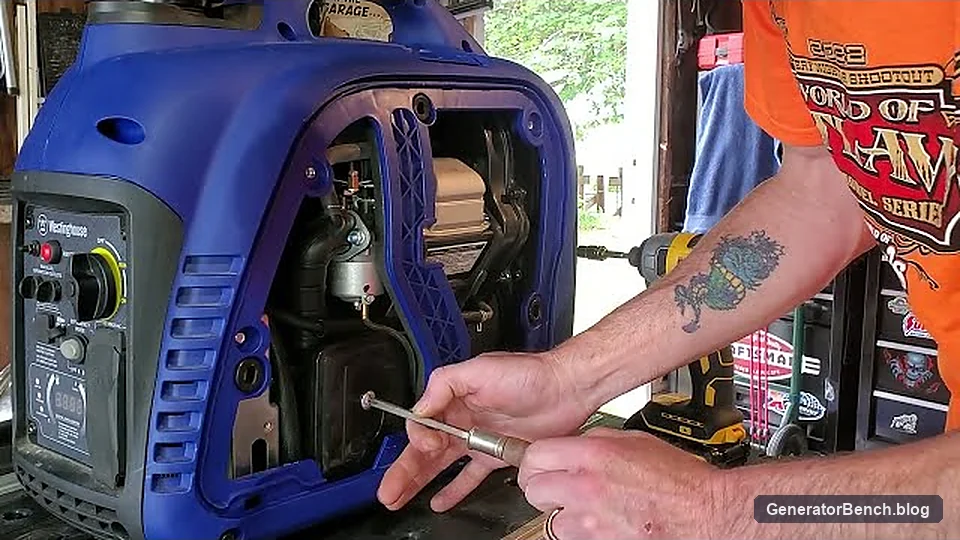
The Westinghouse iGen2200 relies on an 79cc 4-stroke OHV engine built for casual recreational tasks. It delivers dependable torque using standard consumer-grade internal casting tolerances.
Conversely, our Honda EU2200i review highlights its precision-engineered 121cc GXR120 commercial engine. This larger displacement allows Honda to generate rated wattage at lower operating RPMs.
The Westinghouse iGen2200 features a 79cc 4-stroke OHV engine designed for robust torque delivery. Its displacement architecture prioritizes mid-range power output to handle sudden inductive motor surges without immediate stalling.
Conversely, the Honda EU2200i utilizes a slightly larger 121cc GXR120 commercial-grade engine. This precision-engineered displacement provides superior thermal management and mechanical longevity under continuous heavy industrial load profiles.
- Westinghouse uses a 79cc consumer-class displacement.
- Honda features a robust 121cc commercial GXR120 engine.
- Lower operating speeds reduce mechanical stress on Honda.
Internal Thermal Management
Thermal dissipation dictates continuous runtime limits under heavy loads. Westinghouse employs standard air-cooling fins machined directly into the aluminum crankcase block.
Honda integrates advanced airflow channels that isolate the alternator stator from radiant engine heat. This prevents thermal degradation during prolonged high-wattage summer operations.
- Westinghouse uses standard crankcase cooling fins.
- Honda optimizes internal airflow to protect stators.
Inverter Clean Power Quality and THD
Sensitive medical equipment and modern microprocessors demand ultra-clean sinusoidal waveforms. Both generators feature advanced inverter modules that regulate voltage fluctuations tightly.
The Westinghouse unit maintains total harmonic distortion below three percent. Meanwhile, Honda pushes cleaner power with THD ratings consistently resting under two point five percent.
Advanced pulse-width modulation in the Westinghouse unit converts raw DC into stable AC power. It maintains Total Harmonic Distortion below three percent, ensuring safe operation for sensitive microprocessors and modern household electronics.
Honda counters with proprietary inverter microprocessor technology delivering ultra-clean electricity. As detailed in our Honda EU2200i generator review, the unit consistently achieves sub-two percent THD for sensitive equipment.
- Both units protect sensitive laptops and smartphones safely.
- Honda achieves slightly lower total harmonic distortion levels.
- Stable sine waves prevent overheating in inductive loads.
Voltage Regulation Under Surge Loads
Motor-driven appliances require high starting surge wattage. Westinghouse handles sudden compressor kicks with standard electronic governor adjustments.
Honda integrates microprocessors that anticipate electrical draw changes instantly, preventing noticeable voltage sag when heavy motor loads engage.
- Westinghouse relies on standard electronic governors.
- Honda uses predictive microprocessor load tracking.
Operating Acoustics and Decibel Profiles
Campsite etiquette requires minimal acoustic interference from portable power sources. The Westinghouse iGen2200 operates at roughly fifty-two to sixty-two decibels depending on load.
Honda engineers implemented a multi-chamber exhaust system that drops noise output down to forty-eight decibels at quarter load. Proper operation is further detailed within the Honda EU2200i break-in procedure.
Acoustic engineering on the Westinghouse relies on a fully enclosed polymer case. It produces roughly 52 decibels at quarter load, which matches standard conversational volume levels from twenty feet away.
Honda implements a patented triple-chamber exhaust system and dual-fan cooling layout. This configuration dampens high-frequency mechanical noise, dropping baseline sound pressure levels down to 48 decibels during eco-throttle operations.
- Westinghouse noise spans from fifty-two to sixty-two decibels.
- Honda achieves ultra-quiet operation starting at forty-eight decibels.
- Acoustic baffling separates mechanical clatter from exhaust notes.
Enclosure Dampening Materials
Sound suppression heavily relies on dense internal acoustic foam lining. Westinghouse utilizes standard polyurethane batting inside its molded plastic outer shell.
Honda wraps its core components in high-density melamine foam that absorbs broader frequency spectrums, minimizing irritating high-pitched mechanical whines.
- Westinghouse uses standard polyurethane enclosure batting.
- Honda deploys high-density melamine acoustic dampening.
Portability Footprint and Ergonomic Handling
Transporting a portable generator requires balanced weight distribution and comfortable grab handles. The Westinghouse model weighs forty-six point four pounds dry.
Honda matches this mobility closely with a dry weight of forty-seven point four pounds. As noted in our Honda EU2200i Companion review, components sit safely inside a compact, rugged polymer housing.
Weighing forty-six pounds dry, the Westinghouse frame includes a centered, rigid plastic carrying handle. Its compact rectangular geometry fits easily inside standard vehicle trunks alongside camping gear and emergency supplies.
The Honda model weighs slightly less at forty-seven pounds wet, featuring an ergonomically balanced rubber-coated handle. This thoughtful design minimizes wrist strain during transport across uneven terrain or tight campsite pathways.
- Westinghouse weighs 46.4 pounds without fuel loaded.
- Honda measures 47.4 pounds with an ergonomic carry handle.
- Both units fit easily inside standard vehicle trunks.
Chassis Durability and Impact Resistance
Job site environments test the structural integrity of portable inverter housings. Westinghouse builds adequate outer shells that withstand normal recreational handling.
Honda reinforces stress points with thick injection-molded plastics that resist cracking when accidentally bumped against truck beds or concrete slabs.
- Westinghouse uses standard consumer-grade exterior polymers.
- Honda reinforces stress points for heavy contractor use.
Fuel Efficiency and Extended Run Times
Maximizing runtime on a single fuel tank is vital during extended grid outages. Westinghouse includes a one point one gallon tank supplying up to twelve hours at low loads.
Honda matches this with a zero point nine five gallon tank, yet achieves superior efficiency through intelligent throttle management technology.
Equipped with a 1.2-gallon fuel tank, the Westinghouse delivers up to twelve hours of runtime at twenty-five percent load. Activating the efficiency switch optimizes engine RPM to match actual electrical demand.
Honda integrates a 0.95-gallon tank that achieves roughly eight hours under quarter load using Eco-Throttle. Despite smaller capacity, its thermal efficiency extracts maximum energy from every drop of gasoline consumed.
- Westinghouse features a 1.1-gallon fuel capacity.
- Honda utilizes a 0.95-gallon tank with superior economy.
- Eco-throttle systems automatically reduce RPMs under light loads.
Carburetor Design and Fuel Stale Resistance
Stale gasoline frequently clogs small carburetor jets during storage periods. Westinghouse features a standard float bowl drain screw for maintenance access.
Honda includes an integrated fuel shutoff valve that lets the engine run the carburetor dry, preventing varnish buildup effectively.
- Westinghouse provides standard float bowl drain access.
- Honda includes an automated fuel shutoff feature.
Maintenance Protocols and Service Lifespan
Regular upkeep ensures long operational hours from portable generators. Westinghouse outlines standard oil change intervals every one hundred operating hours.
Honda specifies similar oil change schedules but builds internal components with tighter metallurgical tolerances, ensuring extended multi-year service lives.
Routine servicing on the Westinghouse requires standard access panels for spark plug and oil changes. Regular filter cleaning prevents premature wear within dusty outdoor operating environments and demanding job site conditions.
Honda simplifies long-term upkeep with color-coded maintenance touchpoints and a toolless side-access door. Premium metallurgical alloys extend major overhaul intervals, securing exceptional service lifespan across commercial contracting applications.
- Westinghouse requires routine maintenance every 100 hours.
- Honda components feature superior wear resistance metallurgy.
- Both models feature easy-access side maintenance panels.
Spark Arrester and Exhaust Maintenance
Federal parks require certified spark arrestors on all small combustion engines. Both Westinghouse and Honda include easily removable metal screen filters.
Accessing the spark plug and arrester on the Westinghouse requires removing a single panel screw, matching the tool-free convenience found on the Honda.
- Both generators include USDA-qualified spark arrestors.
- Routine cleaning prevents carbon buildup and exhaust choking.
Frequently Asked Questions
Can these two inverters be paralleled together for increased total output?
Yes, both generators support parallel operation using dedicated cables. Parallel kits allow users to double their available running wattage safely.
Which model handles high-altitude camping trips with better efficiency?
Both units require jet re-calibration above five thousand feet. Honda engines traditionally maintain slightly better stoichiometric ratios at high elevations.
Are replacement parts easily accessible for routine owner repairs?
Westinghouse offers widespread parts availability through online distributors. Honda components feature superior dealer support networks for professional service.
Do these generators feature low-oil automatic shutdown safety systems?
Yes, both units include electronic sensors that halt ignition instantly. Low-oil protection prevents catastrophic internal engine seizure during operation.
What type of gasoline should operators use for optimal longevity?
Standard unleaded gasoline with eighty-seven octane works perfectly fine. Ethanol-free fuel is strongly recommended to prevent long-term carburetor gumming.