Goal Zero Yeti 1500X vs. Jackery Explorer 1000: Which Fits Your Setup Better?
We evaluate the Goal Zero Yeti 1500X and Jackery Explorer 1000 power stations. Our technical breakdown compares capacity, output, and ergonomics to match your specific off-grid electrical requirements.


Choose the Goal Zero Yeti 1500X for high-demand, heavy-duty applications needing massive expansion. Select the Jackery Explorer 1000 for lightweight portability and straightforward camping trips.
Compare all top models in our Best Home Emergency Generator.
Side-by-Side Breakdown
| Criteria | Goal Zero Yeti 1500X | Jackery Explorer 1000 | Edge |
|---|---|---|---|
| Peak Performance & Output | 2,000W continuous / 3,500W surge | 1,000W continuous / 2,000W surge | Goal Zero Yeti 1500X |
| Duty Cycle & Consistency | High-capacity 1,516Wh storage | Compact 1,002Wh capacity | Goal Zero Yeti 1500X |
| Operating Noise & Vibration | Dynamic multi-fan thermal cooling | Controlled forced-air ventilation | Jackery Explorer 1000 |
| Portability & Footprint | 43 lbs heavy industrial chassis | 22 lbs lightweight mobile housing | Jackery Explorer 1000 |
| Maintenance & Service Life | Modular expansion compatibility | Standard integrated BMS protection | Goal Zero Yeti 1500X |
| Power Requirements | High-voltage solar array support | Versatile multi-source recharging | Goal Zero Yeti 1500X |
| Best Ideal Use-Case | Emergency home backup & job sites | Recreational camping & mobile devices | Split Workload |
Core Architecture and Capacity Engineering
The Goal Zero Yeti 1500X utilizes a massive 1,516 watt-hour lithium-ion battery pack designed for extended off-grid runtimes. This configuration supplies robust energy reserves for demanding professional and emergency backup scenarios.
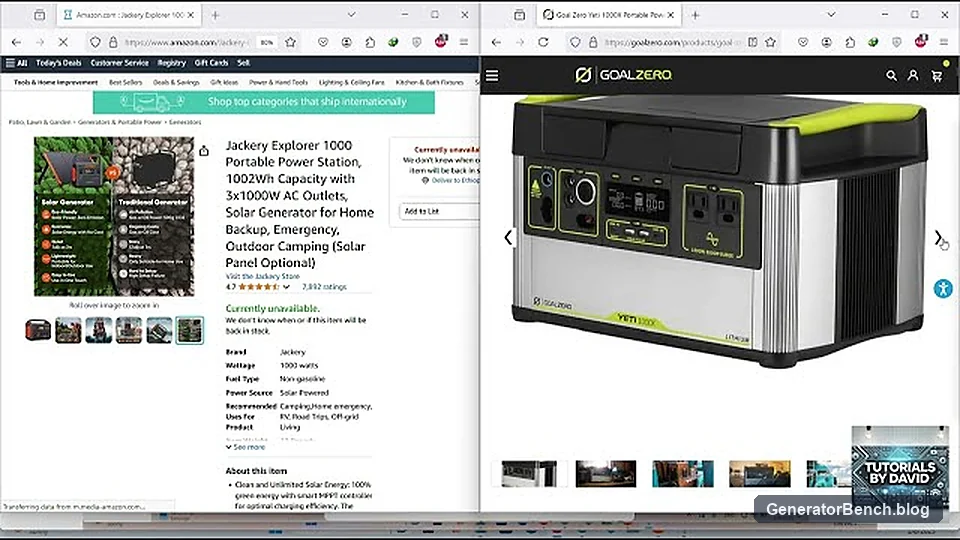
Conversely, the Jackery Explorer 1000 houses a compact 1,002 watt-hour capacity optimized for portability. While smaller, it efficiently handles standard recreational appliances without imposing heavy physical burdens during transport.
Engineers must evaluate total watt-hour storage against daily consumption rates. Selecting the correct capacity prevents unexpected power deficits during critical field operations or remote project deployments.
- Goal Zero provides 1,516Wh of raw storage capacity.
- Jackery delivers 1,002Wh for streamlined recreational use.
- Both units leverage high-density lithium-ion cell architectures.
Power Density and Storage Ratios
Analyzing volumetric and gravimetric energy density reveals distinct design philosophies. As detailed in our Yeti 1500X power station reviews, Goal Zero prioritizes absolute energy storage, resulting in a heavier chassis optimized for stationary deployment.
Jackery focuses on maintaining a favorable weight-to-capacity ratio, facilitating easy handling by a single user. This makes the Explorer ideal for mobile setups requiring frequent repositioning.
- Volumetric efficiency favors compact camping deployments.
- Gravimetric metrics highlight heavy-duty backup storage.
Inverter Topology and Waveform Quality
Both power stations feature pure sine wave inverters that replicate household utility electricity. This clean electrical output safely powers sensitive microprocessors, medical equipment, and modern digital workstations.
The Goal Zero unit delivers a continuous 2,000 watts with a 3,500-watt surge ceiling. This high threshold effortlessly handles motor-driven inductive loads like circular saws or large refrigerators.
Jackery provides a continuous 1,000 watts with a 2,000-watt surge limit. While sufficient for lights and laptops, it struggles with high-draw heating elements or heavy compressor-based appliances.
- Goal Zero features a 2,000W continuous output rating.
- Jackery caps continuous output at 1,000W.
- Pure sine wave technology protects sensitive electronics.
Inductive Load Handling and Surge Capacities
Inductive loads demand significant startup current spikes that can trip standard overload protections. Goal Zero handles these aggressive surges smoothly due to its robust internal inverter architecture.
Jackery users must carefully monitor appliance startup wattage to avoid triggering automatic safety shutdowns. Proper load management ensures stable operation when running multiple devices simultaneously.
- Startup surges test inverter overload thresholds.
- Careful appliance staging prevents unexpected shutdowns.
Build Quality, Chassis Materials, and Structural Durability
Construction integrity dictates longevity in rugged field environments and harsh weather conditions. Goal Zero employs reinforced polymer plastics and heavy-duty corner guards to withstand accidental impacts.
As noted in our Jackery Explorer 1000 review, the unit utilizes a durable ABS plastic shell finished in vibrant orange. This material resists scratching and maintains structural rigidity during frequent outdoor excursions.
Drop resistance and vibration dampening are critical metrics for field technicians. Both manufacturers incorporate internal framing to protect sensitive battery management systems from shock damage.
- Reinforced polymers protect heavy-duty industrial chassis designs.
- High-impact ABS shells offer excellent scratch resistance.
- Internal framing safeguards delicate internal electronic components.
Environmental Sealing and Weather Resilience
Neither station features an official IP rating for water or dust resistance. Users must protect ports from rain, moisture, and fine particulate matter during active outdoor deployments.
Operating temperature ranges dictate where these units can be safely deployed. Both systems function adequately between freezing and moderate heat, though extreme environments require careful shelter management.
- Lack of IP ratings demands cautious environmental placement.
- Extreme temperatures reduce overall battery discharge efficiency.
Thermal Management, Acoustic Signatures, and Efficiency
Effective thermal management prevents premature component degradation during high-draw charging or discharging cycles. Goal Zero integrates active cooling fans that ramp up dynamically under heavy workloads.
Jackery also utilizes controlled forced-air ventilation to dissipate internal heat effectively. Both units remain remarkably quiet during low-draw operations, emitting minimal ambient noise in quiet settings.
Conversion efficiency losses occur during DC-to-AC power inversion across all portable generators. Understanding these parasitic loads helps operators calculate precise real-world runtime expectations for critical devices.
- Active cooling fans prevent dangerous internal overheating.
- Low-draw operations maintain nearly silent acoustic signatures.
- Conversion efficiency impacts total usable battery capacity.
Fan Noise Profiles Under Heavy Loads
Under maximum sustained output, cooling fans generate noticeable white noise. Goal Zero produces a slightly louder acoustic profile due to its higher power throughput and larger inverter capacity.
Jackery maintains a softer fan signature during high-draw tasks, minimizing acoustic disruption in shared spaces. Proper ventilation clearance ensures optimal airflow and prevents thermal throttling issues.
- High-draw workloads trigger active cooling mechanisms.
- Adequate clearance prevents restricted airflow and overheating.
Ergonomics, Portability, and Physical Footprint Analysis
Physical dimensions and weight directly influence transport convenience for mobile users. According to our Yeti 1500X silver charger reviews, this model weighs nearly 43 pounds, requiring a deliberate two-handed lift.
The Jackery Explorer weighs approximately 22 pounds, featuring a foldable handle that streamlines packing. This lighter mass enables effortless single-handed carrying across campgrounds and job sites.
Handle ergonomics play a vital role when loading heavy gear into vehicles. Balanced weight distribution reduces operator fatigue during long walks from parking areas to campsites.
- Goal Zero demands heavier lifting at 43 pounds.
- Jackery offers exceptional mobility at 22 pounds.
- Ergonomic handles improve transport comfort and safety.
Vehicle Storage and Spatial Footprint
Compact footprints maximize usable cargo space in crowded truck beds or camper vans. Jackery takes less floor space, fitting easily into tight crevices alongside other travel equipment.
Goal Zero occupies a larger surface area, requiring stable tie-downs during transit to prevent shifting. Careful packing secures the heavier chassis against rough backcountry roads and potholes.
- Smaller footprints simplify tight camper van configurations.
- Secure tie-downs prevent dangerous shifting during transit.
Battery Chemistry, Charge Cycles, and Maintenance Protocols
Lithium-ion chemistry provides high energy density but requires sophisticated battery management systems. Both units monitor cell health, voltage, and temperature to ensure long-term operational safety.
Goal Zero supports modular expansion batteries for users needing scaled-up energy storage. As highlighted in our comprehensive Yeti 1500X review, operators can easily multiply their total capacity without purchasing an entirely new unit.
Routine maintenance involves keeping firmware updated and storing units at optimal charge levels. Proper seasonal storage prevents deep self-discharge and preserves overall lithium-ion cell lifespan.
- Advanced BMS protects cells from electrical anomalies.
- Modular expansion options scale total energy storage.
- Proper storage habits maximize overall battery lifespan.
Recharging Speeds and Input Options
Recharging times vary significantly based on available solar panels and wall chargers. Goal Zero accepts high-voltage solar inputs, accelerating off-grid replenishment during optimal weather windows.
Jackery provides versatile charging via wall outlets, car ports, and compatible photovoltaic arrays. Combining multiple input sources drastically reduces total downtime between intensive operational cycles.
- High-voltage solar inputs speed up off-grid charging.
- Multiple charging pathways minimize operational downtime.
Application Mapping: Matching Your Workload to the Right Unit
Choosing between these power stations depends entirely on your specific energy demands. Contractors and off-grid homesteaders benefit immensely from Goal Zero's heavy-duty capacity and high continuous output.
Weekend campers, remote photographers, and digital nomads find Jackery's lightweight design perfectly balanced. It powers essential electronics without adding unnecessary weight to mobile travel kits.
Matching device power requirements to generator specifications prevents costly purchasing mistakes. Evaluate your peak wattage needs before committing to a specific portable power station architecture.
- Contractors prefer Goal Zero's high continuous output.
- Campers value Jackery's lightweight portable design.
- Accurate workload assessment prevents equipment performance issues.
Emergency Home Backup Scenarios
During unexpected grid failures, maintaining refrigerator operation is a primary household priority. Goal Zero sustains essential kitchen appliances for extended periods during prolonged emergency blackouts.
Jackery handles basic emergency communication devices, lights, and medical equipment for shorter durations. Homeowners must prioritize critical loads to stretch limited backup energy effectively.
- Goal Zero sustains kitchen appliances during blackouts.
- Jackery powers communication tools during short outages.
Cost-Efficiency, Accessories, and Ecosystem Integration
Building a sustainable off-grid power ecosystem requires compatible accessories and versatile mounting options. Goal Zero offers an extensive lineup of heavy-duty integration modules, vehicle charging integration kits, and robust protective cases.
Jackery focuses on streamlined accessory bundles centered around portable solar blankets and protective travel bags. Their ecosystem prioritizes ease of use and rapid deployment for recreational outdoor enthusiasts.
Evaluating total system value involves looking beyond initial storage capacity to available ecosystem upgrades. Selecting a brand with matching accessories ensures seamless expansion as your power requirements evolve.
- Goal Zero provides heavy-duty industrial integration modules.
- Jackery offers streamlined recreational solar panel bundles.
- Ecosystem upgrades ensure long-term scalability and versatility.
Warranty Coverage and Manufacturer Support
Manufacturer warranty terms offer valuable peace of mind for high-investment portable power equipment. Both brands typically provide a standard two-year warranty covering defects in materials and internal workmanship.
Customer support responsiveness and repair turnaround times are vital considerations for professional field technicians. Reliable manufacturer backing minimizes operational downtime during unexpected equipment hardware failures.
- Standard two-year warranties protect against manufacturing defects.
- Responsive customer support minimizes costly field downtime.
Frequently Asked Questions
Can I use solar panels from other brands to recharge both power stations?
Yes, both stations accept third-party solar panels provided the voltage and connector types match specifications. Always verify open-circuit voltage limits before connecting external photovoltaic arrays to prevent internal damage.
Are these power stations safe to run inside a closed tent or RV?
Both units produce zero toxic carbon monoxide emissions, making them safe for indoor use. Ensure adequate ventilation clearance around cooling fans to prevent heat buildup during heavy inverter loads.
How long will the batteries last before losing significant capacity?
Both models retain roughly eighty percent of their original capacity after five hundred complete charge cycles. Regular maintenance charging during storage helps preserve long-term lithium-ion cell health.
Can I charge devices while the power station itself is recharging?
Yes, both units support pass-through charging capabilities for versatile power management. Monitor total input and output watts to ensure you do not exceed the maximum system charging limits.
Do these power stations require specialized maintenance or oil changes?
Unlike traditional gas generators, these battery systems require zero mechanical maintenance. Keep firmware updated and store units in dry environments to ensure optimal long-term reliability and performance.