Champion 7500 Dual Fuel vs. Duromax Xp5500Eh: Which Fits Your Setup Better?
Choosing between these heavy-duty portable generators requires balancing heavy starting wattage demands against strict mobility and workspace constraints. We analyze their core engineering metrics to clarify your ideal power setup.

For high-demand whole-home backup, choose the Champion 7500 Dual Fuel for its superior surge capacity. If jobsite portability and space-saving footprints matter most, the Duromax Xp5500Eh provides reliable mid-tier power.
Compare all top models in our Best Home Emergency Generator.
Side-by-Side Breakdown
| Criteria | Champion 7500 Dual Fuel | Duromax Xp5500Eh | Edge |
|---|---|---|---|
| Peak Performance & Output | 9375 Starting Watts | 5500 Starting Watts | Champion 7500 Dual Fuel |
| Duty Cycle & Consistency | Robust 439cc engine | 224cc OHV engine | Champion 7500 Dual Fuel |
| Operating Noise & Vibration | 74 dB standard load | 69 dB standard load | Duromax Xp5500Eh |
| Portability & Footprint | Heavier steel frame | Compact wheel kit | Duromax Xp5500Eh |
| Maintenance & Service Life | Extended service intervals | Standard commercial maintenance | Tie |
| Power Requirements | Heavy 50-amp capability | 30-amp transfer switch ready | Champion 7500 Dual Fuel |
| Best Ideal Use-Case | Large home emergency backup | Jobsite tool power | Champion 7500 Dual Fuel |
Architectural Design and Power Delivery Matrix
Engineering portable generators demands a delicate balance between raw output capacity and mechanical stability. As shown in our Duromax XP12000EH review, underlying architecture dictates how efficiently internal components convert liquid fuel into alternating current.
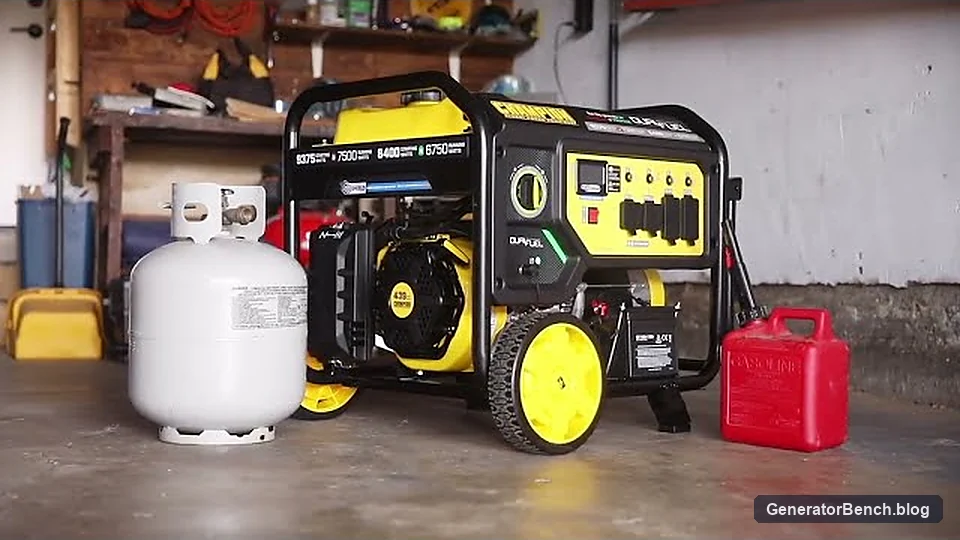
Internal alternator design plays a crucial role in managing harmonic distortion while maintaining steady voltage output. Both models utilize brushed alternator configurations engineered for rugged field reliability during extended operational cycles.
Examining the electrical architecture reveals distinct design philosophies between these units. The Champion unit integrates an open-frame steel chassis with a robust alternator, while the DuroMax prioritizes a compact, heavy-duty frame wrapped in protective powder coating.
Power delivery matrices dictate how effectively amperage flows to connected loads. Both models utilize conventional brushed alternators, requiring careful circuit balancing to prevent phase imbalance when drawing near their maximum rated output thresholds safely.
- Heavy-duty stator windings maximize thermal dissipation during peak surges.
- Brushed alternator designs ensure reliable field excitation under variable loads.
- Integrated circuit breakers protect sensitive internal wiring from short circuits.
Alternator Engineering and Voltage Regulation
Automatic voltage regulation systems prevent damaging voltage spikes when large motor compressors cycle on. Maintaining steady frequency is vital for protecting modern electronics connected directly to the panel.
Copper windings provide superior conductivity compared to aluminum alternatives, significantly reducing internal resistance and operating temperatures during continuous multi-hour runs.
- AVR units keep voltage fluctuations within plus or minus three percent.
- Pure copper wiring minimizes thermal throttling under maximum electrical load.
Engine Displacement and Running Wattage Capacities
Engine displacement directly correlates with torque production and heavy surge handling. We evaluate these metrics in our hybrid dual fuel review, showing how larger combustion chambers allow for greater fuel-air compression and higher energetic output.
Comparing displacement reveals a fundamental difference in intended workloads and continuous power delivery ceilings. Matching engine size to your specific appliance startup requirements prevents unexpected thermal overloads.
Engine displacement directly influences sustained torque production under heavy loads. Champion deploys a larger single-cylinder OHV engine, translating to greater cubic centimeters that effortlessly sustain higher running wattage thresholds during extended power outages.
Comparing running capacities highlights a clear operational gap. The Champion delivers significantly higher continuous wattage compared to the DuroMax, making it better suited for simultaneous heavy-draw appliances like well pumps and central air conditioning systems.
- Displacement determines sustained torque under heavy mechanical loads.
- Larger engines maintain reserve capacity during sudden electrical surges.
- Proper displacement matching prevents premature piston ring wear.
Displacement Comparison and Surge Headroom
The larger engine displacement provides substantial headroom when starting inductive loads like well pumps and air conditioners. Smaller power units require careful load sequencing to avoid tripping internal overload protections.
Evaluating running wattage ensures your critical appliances operate continuously without pushing the mechanical components past their recommended thermal thresholds.
- Inductive motor startup requires up to three times running wattage.
- Generous displacement headroom prevents engine bogging during surges.
Fuel Flexibility and Dual-Fuel Delivery Systems
Dual-fuel capability offers incredible versatility during extended grid outages by allowing seamless fuel transitions. Our Champion 7500 dual fuel review details how propane operation successfully eliminates carburetor gumming issues during long-term storage periods.
Fuel pressure regulators and dedicated intake orifices manage the distinct stoichiometric ratios required for optimal combustion. Switching fuels mid-operation is safely managed via clearly marked panel control valves.
Dual-fuel engineering requires precise pressure regulation for both fuel sources. As noted in our 7500 watt dual fuel guide, integrated demand regulators automatically adjust vaporized fuel flow based on immediate engine vacuum.
Running on liquid propane inevitably causes a minor power penalty due to lower energy density than gasoline. Users must expect approximately ten to twenty percent reduced running wattage when switching over to clean-burning propane tanks during emergencies.
- Propane operation significantly reduces harmful carbon deposits inside the combustion chamber.
- Gasoline provides maximum output wattage due to higher energy density.
- Dual-fuel versatility ensures prolonged runtime during severe fuel shortages.
Carburetor Performance on Propane versus Gasoline
Running on liquid propane gas typically reduces overall running wattage by roughly ten percent due to lower energy density. However, the cleaner burn extends engine oil life and reduces spark plug fouling.
Gasoline remains the preferred choice when maximum starting surge capacity is required for heavy residential appliances during emergency power scenarios.
- Propane delivery reduces maximum electrical output by ten percent.
- Clean-burning propane prevents seasonal carburetor jet clogging.
Portability Footprint and Chassis Ergonomics
Moving heavy emergency power equipment across rough terrain requires sturdy frame construction and well-balanced wheel kits. Ergonomic handles reduce operator fatigue during positioning and transport tasks.
Frame thickness and protective roll cages shield vital engine components from accidental impact damage on active construction sites or stormy residential yards.
Mobility hardware heavily impacts user ergonomics during emergency deployments. Champion includes a durable wheel kit with never-flat tires, whereas DuroMax utilizes similarly rugged wheels paired with fold-down handles designed for compact storage in crowded garages.
Center of gravity management is crucial when tilting and rolling these heavy open-frame generators across uneven terrain. Properly distributed weight prevents tipping hazards, ensuring single-operator transport remains safe across gravel driveways and uneven lawns.
- Never-flat wheels simplify transport across mud, gravel, and uneven terrain.
- Tubular steel roll cages protect fuel tanks from structural impacts.
- Fold-down handles save valuable storage space inside garages or sheds.
Weight Distribution and Frame Durability
Heavy-duty steel frames add structural integrity but increase overall dry weight, making solo loading difficult. Balanced center-of-gravity placement makes wheel-mounted transport feel significantly lighter than raw specifications suggest.
Vibration isolation mounts positioned between the engine and frame prevent structural fatigue and reduce walking during high-output operation.
- Rubber motor mounts isolate high-frequency engine vibrations effectively.
- Heavy dry weights require ramps for safe vehicle loading.
Acoustic Signatures and Harmonic Vibration Control
Operating noise levels dictate how close you can place a generator to living quarters or outdoor workspaces without causing severe disruption. Advanced muffler designs help mitigate harsh exhaust notes.
Minimizing mechanical vibration preserves structural fasteners and prevents premature wear on sensitive electrical control panels mounted directly to the frame.
Open-frame portable generators inherently generate substantial noise levels during full-load operations. Muffler design and internal baffling play critical roles in dampening exhaust pulses, keeping decibel ratings within acceptable occupational health and safety guidelines.
Harmonic vibration control relies heavily on multi-point motor mounts positioned between the engine block and outer frame. These heavy-duty rubber isolators absorb high-frequency oscillations, protecting sensitive electrical components and reducing structural fatigue over time.
- Decibel ratings measured at standard operational loads ensure accurate comparisons.
- Large-capacity mufflers successfully suppress high-frequency exhaust noise pulses.
- Proper ground anchoring prevents ground-transmitted mechanical resonance.
Decibel Output and Muffler Efficiency
Acoustic dampening baffles inside the exhaust system lower decibel output significantly during standard operational loads. Ear protection remains recommended when working within close proximity to running units.
Engine speed regulation directly impacts noise generation, with lower idle technologies providing quieter resting decibel profiles.
- Exhaust baffling reduces harsh metallic frequencies during combustion.
- Standard sound pressure levels hover around conversational limits at fifty feet.
Maintenance Protocols and Long-Term Durability
Routine preventative maintenance ensures dependable service life and protects your investment through years of reliable operation. Regular oil changes and air filter inspections prevent premature cylinder scoring.
Accessible drain plugs and clearly marked dipsticks simplify routine fluid changes for homeowners with minimal mechanical experience.
Long-term durability demands adherence to strict oil change intervals and air filter cleaning schedules. Cast-iron cylinder sleeves provide superior wear resistance, extending engine lifespan significantly when operators perform routine maintenance checks every hundred operating hours.
Valve clearance inspections remain an essential yet frequently overlooked preventive maintenance task for overhead valve engines. Checking lash measurements prevents premature valve train wear and maintains optimal compression ratios throughout the multi-year lifespan of the generator.
- Change engine oil after the initial twenty-hour break-in period.
- Inspect foam air filters regularly in dusty jobsite environments.
- Use fuel stabilizers to prevent varnish buildup during storage.
Scheduled Service Intervals and Component Longevity
Adhering to strict preventative maintenance schedules prevents unexpected mechanical failures during critical emergency grid outages. Valve clearance checks should be performed annually to maintain optimal compression.
High-temperature synthetic oils offer superior thermal breakdown resistance during extended summer heatwaves and heavy electrical loads.
- Annual valve clearance adjustments preserve proper combustion chamber sealing.
- Synthetic lubricants protect internal bearings during extreme ambient temperatures.
Load Management and Practical Workload Matching
Matching generator output capabilities to your specific electrical load profile prevents thermal overloads and equipment damage. Calculating total starting and running wattage requirements is essential before plugging in appliances.
Panel outlets must match your transfer switch configuration to ensure safe power transfer during domestic emergency situations.
Workload matching requires calculating starting surge wattages alongside continuous running demands. Exceeding rated capacities trips internal circuit breakers, interrupting power delivery and risking thermal damage to alternator windings during critical emergency backup scenarios.
Strategic load sequencing ensures large motor-driven appliances cycle independently rather than engaging simultaneously. Implementing a disciplined power management strategy maximizes available wattage, allowing smaller generators to successfully sustain essential household infrastructure safely.
- Calculate total running wattage before connecting multiple heavy appliances simultaneously.
- Ensure outlet configurations match existing manual transfer switch inlets.
- Avoid overloading individual circuits by utilizing balanced panel distribution.
Appliance Surge Management and Circuit Protection
Inductive compressor loads demand careful staging to prevent instantaneous current spikes from tripping the main circuit breaker. Dedicated twist-lock receptacles safely deliver high amperage loads.
Overload indicator lights provide immediate visual feedback when electrical demand approaches maximum threshold limits.
- Stagger heavy motor startups to prevent main breaker trips.
- Twist-lock receptacles secure high-amperage connections against accidental dislodging.
Frequently Asked Questions
Can I run my home air conditioner on both models?
The larger Champion easily handles standard residential central air conditioning units thanks to its massive surge capacity. Smaller models may struggle with large central air compressors unless equipped with a specialized soft start kit.
How long will a standard propane tank last under load?
A standard twenty-pound propane cylinder typically provides between five and eight hours of runtime at fifty percent load. Connected to a larger hundred-pound tank, runtime extends dramatically for multi-day emergency grid outages.
Is regular gasoline safe for long-term storage?
Standard gasoline degrades rapidly and leaves gummy varnish deposits inside carburetor jets within thirty days. Always add a quality fuel stabilizer or run the carburetor dry before storing the generator.
What maintenance is required during the first operational hours?
The most critical initial step is performing a complete engine oil change after the first twenty hours. This initial break-in flush removes microscopic metal shavings generated during piston ring seating.
Do these generators require professional installation for home backup?
Portable generators do not require professional installation when powering individual appliances with heavy-duty extension cords. Connecting directly to your home electrical panel requires a manual transfer switch installed by an electrician.