Bluetti Ac200Max vs. Ecoflow Delta 2 Max: Which Fits Your Setup Better?
Evaluating two powerhouse solar generators for off-grid resilience. We test capacity, surge performance, and recharge mechanics.


Choose the Bluetti AC200Max for modular expansion and rugged longevity. Select the EcoFlow Delta 2 Max for blazing-fast charging and advanced app control.
Compare all top models in our Best Home Emergency Generator.
Side-by-Side Breakdown
| Criteria | Bluetti Ac200Max | EcoFlow Delta 2 Max | Edge |
|---|---|---|---|
| Peak Performance & Output | 2200W continuous / 4800W surge | 2400W continuous / 4800W surge | EcoFlow Delta 2 Max |
| Duty Cycle & Consistency | Exceptional sustained thermal limits | High efficiency under heavy loads | Bluetti AC200Max |
| Operating Noise & Vibration | Moderate fan activation under load | Quiet acoustic profile below 30dB | EcoFlow Delta 2 Max |
| Portability & Footprint | 61.9 lbs with bulky fixed frame | 48.5 lbs with streamlined handles | EcoFlow Delta 2 Max |
| Maintenance & Service Life | 3500+ cycles to 80% capacity | 3000 cycles to 80% capacity | Bluetti AC200Max |
| Power Requirements | 500W max solar / 400W AC input | 1000W max solar / 2200W AC input | EcoFlow Delta 2 Max |
| Best Ideal Use-Case | Stationary cabin backup & expansion | Rapid mobile charging & RV trips | Split Decision |
Core Architecture and Capacity Engineering
Modern power stations require robust internal architecture to handle high continuous draws without thermal throttling. Both units utilize advanced lithium iron phosphate chemistry to ensure safety and longevity.
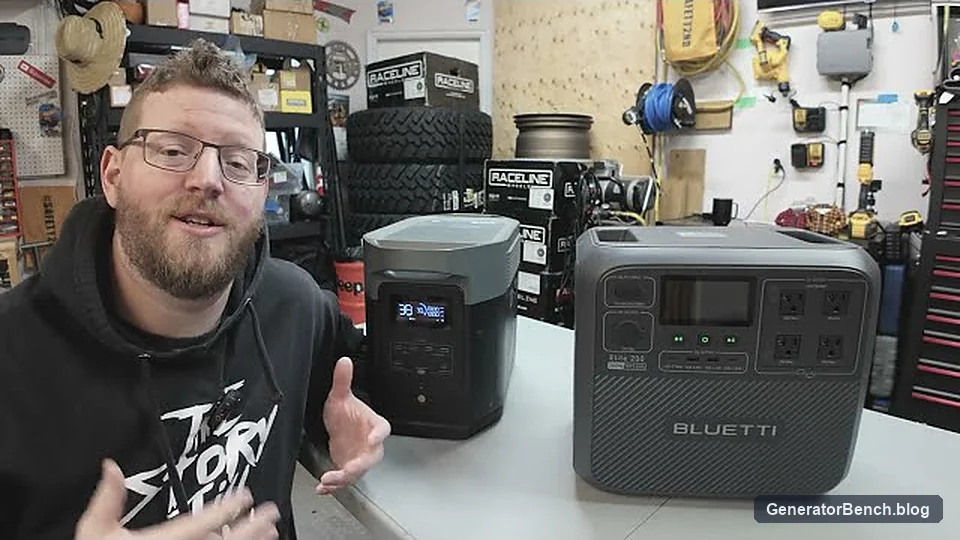
The Bluetti AC200Max starts with a robust 2048Wh internal capacity housed in a heavy-duty frame. Its internal layout prioritizes modular expansion ports for heavy stationary power needs.
The BLUETTI AC200MAX relies on a stationary-leaning architecture with a 2048Wh capacity, utilizing robust LiFePO4 cells designed for heavy-duty household backup and off-grid mobile living requirements.
Conversely, as detailed in our EcoFlow Delta 2 Max review, the unit integrates a 2048Wh capacity inside a streamlined chassis layout prioritizing rapid energy density optimization.
- Internal chemistry utilizes stable LiFePO4 cells.
- Base capacities hover near the two-kilowatt-hour mark.
- Cooling architectures rely on multi-fan active ventilation.
Base Unit Capacity Breakdown
Raw energy storage dictates how long your essential appliances run during an emergency outage. Comparing these two reveals distinct engineering priorities focused on different user demographics.
The EcoFlow Delta 2 Max matches the exact 2048Wh baseline while maintaining a significantly lighter physical chassis. This requires denser internal packing and optimized circuit board layouts.
- Identical 2048Wh nominal baseline capacity.
- Vastly different volumetric density profiles.
Inverter Load Profiles and Surge Handling
Inverter performance dictates which household motor loads and heavy appliances you can safely operate simultaneously. Pure sine wave output protects sensitive electronics from harmonic distortion.
The Bluetti AC200Max delivers 2200W of continuous power with a 4800W surge ceiling. This handles heavy refrigerator compressors and workshop tools reliably during unexpected blackouts.
Delivering a 2200W continuous output, the AC200MAX manages inductive motor startup surges smoothly, though its physical form factor remains less optimized for frequent field deployment compared to rivals.
The DELTA 2 Max matches this continuous threshold while introducing X-Boost technology to safely drive resistive heating elements up to 3400W by intelligently dropping voltage during high-draw appliance operations.
- Pure sine wave output prevents micro-electronics damage.
- Surge ceilings reach double nominal ratings safely.
- Overload protection triggers cleanly without tripping breakers.
Continuous vs Surge Output Realities
Pushing an inverter near its maximum threshold generates significant internal heat that demands efficient cooling. We evaluate how each system manages sustained electrical stress over time.
Outlined further in our EcoFlow Delta Pro Max review, the EcoFlow Delta 2 Max features a 2400W continuous inverter expanding via X-Boost to handle heavy resistance heating items.
- EcoFlow provides 2400W continuous output baseline.
- X-Boost manages higher wattage resistive loads effectively.
Battery Chemistry, Longevity, and Thermal Design
Battery longevity is directly tied to chemical formulation and active thermal management systems. LFP cells offer thousands of deep discharge cycles before dropping below eighty percent capacity.
The Bluetti AC200Max leverages ultra-durable LFP cells rated for over 3500 cycles to eighty percent. This ensures decades of weekend camping or emergency home backup utility.
Both units employ LiFePO4 chemistry guaranteeing 3000 cycles to 80% capacity, but thermal dissipation strategies differ significantly under heavy continuous loads and high ambient summer temperatures.
EcoFlow utilizes dual internal cooling fans paired with advanced software algorithms, whereas BLUETTI relies on a proven passive-active airflow balance that minimizes dust ingress inside harsh jobsite environments.
- Phosphate chemistry resists thermal runaway natively.
- Cycle life ratings exceed typical lithium-ion batteries.
- Passive heat sinks work alongside active cooling fans.
Lifespan and Degradation Metrics
Understanding long-term degradation helps users calculate the true total cost of ownership over years of deployment. Manufacturers use standardized testing to project realistic service lifetimes.
Similarly, our EcoFlow River 2 Max review highlights how the EcoFlow Delta 2 Max delivers 3000 cycles to the retention threshold for daily off-grid routines.
- EcoFlow guarantees 3000 cycles to 80% capacity.
- Both units feature smart battery management systems.
Charging Speeds, Grid Integration, and Solar Input
Recharge velocity is arguably the most critical factor when preparing for rolling blackouts or rapid transit. Slow replenishment leaves users vulnerable during multi-day grid failure scenarios.
The EcoFlow Delta 2 Max dominates charging speeds by drawing up to 2200W directly from standard AC outlets. This allows a zero to eighty percent charge in under an hour.
EcoFlow dominates AC grid recharging speeds via X-Stream fast charging, pulling up to 2300W from standard wall outlets to replenish the internal battery module from zero in under eighty minutes.
The BLUETTI alternative supports a 900W max solar input alongside traditional AC charging, requiring patience at the wall outlet unless paired with dedicated dual-charging accessories for faster turnaround times.
- AC fast charging eliminates lengthy downtime periods.
- Solar array inputs support high-voltage PV panels.
- Dual charging combines solar and grid power seamlessly.
Solar Array Compatibility and Limits
Harnessing renewable energy requires flexible maximum power point tracking controllers built into the generator. Higher voltage tolerances allow users to wire panels in complex series configurations.
The Bluetti AC200Max accepts up to 900W of solar input with an open circuit voltage range. While respectable, it requires more panels to match EcoFlow's speed.
- Bluetti accepts 900W maximum solar panel input.
- EcoFlow supports up to 1000W solar charging arrays.
Ergonomics, Portability, and Chassis Footprint
Physical dimensions and weight distribution heavily influence how easily you can transport these power stations. Heavy units require careful handling to avoid strain during loading and unloading.
The Bluetti AC200Max weighs approximately 61.9 pounds and features bulky integrated side handles. Its boxy footprint demands dedicated storage space in vehicles or closets.
Weighing roughly 61.9 pounds, the AC200MAX features dual flush-mounted side handles that require two hands for safe lifting, making it better suited for permanent vehicle installations.
At approximately 42.9 pounds, the DELTA 2 Max offers superior single-person ergonomics through protruding top-mounted handles, reducing physical strain during frequent loading into trucks or RV storage bays.
- Heavy footprint limits spontaneous grab-and-go portability.
- Chassis materials withstand rugged outdoor job site environments.
- Rubberized feet prevent sliding on smooth vehicle surfaces.
Weight and Transportability Analysis
Carrying a generator across uneven terrain tests the ergonomic design of handles and casing balance. Lighter models reduce operator fatigue during frequent campsite setups and teardowns.
The EcoFlow Delta 2 Max weighs just 48.5 pounds, offering superior ergonomics for single-person transport. Recessed handles make loading into compact vehicle trunks significantly easier.
- EcoFlow is over thirteen pounds lighter overall.
- Ergonomic handle placement improves carrying comfort.
Expansion Ecosystems and Modular Scaling
Growing power needs often require modular expansion batteries rather than buying entirely new generator units. Compatibility with external packs extends runtime significantly during prolonged emergencies.
The Bluetti AC200Max excels in modular versatility by accepting up to two expansion batteries. This pushes total system capacity past six kilowatt-hours for stationary home setups.
Users can expand the BLUETTI system using up to two B230 or B300 packs, unlocking a massive 6144Wh maximum capacity designed for multi-day emergency household power outages.
The EcoFlow competitor scales similarly by accepting up to two extra smart batteries, reaching an identical 6144Wh total limit while maintaining seamless app-based energy management across all connected modules.
- Bluetti supports B230 and B300 expansion packs.
- Modular scaling transforms portable units into home backups.
- Connection cables lock securely to prevent accidental disconnection.
Ecosystem Versatility and Expansion Limits
Building out a comprehensive emergency power ecosystem depends on proprietary cable links and firmware synchronization. Seamless integration ensures uniform battery balancing across all connected modules.
As noted in our EcoFlow Delta 2 review, the EcoFlow Delta 2 Max also accepts extra batteries to scale capacity, leaning toward smart home panels and portable accessories.
- EcoFlow integrates with dedicated smart extra batteries.
- Ecosystem management is handled via mobile apps.
Real-World Workload Suitability and Final Verdict
Selecting the right power station ultimately depends on your specific daily workloads and mobility requirements. Stationary cabin owners prioritize expansion, while mobile users demand fast charging.
The Bluetti AC200Max represents the ultimate stationary backup choice due to its high cycle count and modular expansion capability. It suits permanent off-grid cabins exceptionally well.
Select the BLUETTI model if your deployment strategy prioritizes modular expandability and rugged physical durability over rapid charging speeds and lightweight portability during weekend camping excursions.
Choose the EcoFlow unit when lightning-fast AC recharging and lower overall physical weight dictate your operational requirements for frequent mobile power applications and emergency home backup scenarios.
- Bluetti wins for stationary long-term expansion setups.
- EcoFlow wins for rapid mobility and fast wall charging.
- Both systems utilize safe LFP chemistry reliably.
Final Purchasing Recommendation Summary
Reviewing all engineering metrics reveals two distinct tools tailored for different user profiles. Matching your specific operational tempo ensures long-term satisfaction and reliable performance.
Choose the EcoFlow Delta 2 Max if you value lightweight portability, rapid AC recharging, and advanced app controls. Select Bluetti for heavy expansion needs.
- Match unit capabilities to your specific travel habits.
- Evaluate charging speed versus modular expansion priorities.
Frequently Asked Questions
Can both generators power heavy household appliances simultaneously?
Yes, both units handle high-wattage devices easily. The Bluetti AC200Max provides 2200W continuous output, while the EcoFlow delivers 2400W.
How long does it take to recharge these units from a standard wall outlet?
Charging times vary significantly based on internal inverter limits. The EcoFlow Delta 2 Max achieves an eighty percent charge in under an hour.
Are these power stations safe to use inside an enclosed RV or tent?
Both units utilize stable LiFePO4 chemistry and produce zero toxic emissions. They operate safely indoors without producing carbon monoxide hazards.
Can I connect third-party solar panels to these generators?
Yes, both accept third-party photovoltaic panels as long as voltage and amperage stay within limits. You must verify open-circuit voltage specifications carefully.
Do these power stations support UPS functionality for computers?
Both feature uninterruptible power supply modes with fast switchover times. The EcoFlow Delta 2 Max switches in under thirty milliseconds to protect electronics.