Anker Solix F2000 vs. Ecoflow Delta Pro: Which Fits Your Setup Better?
Comparing two heavy-duty power stations reveals distinct design philosophies. Engineering metrics dictate real-world performance.


Choose the Ecoflow Delta Pro for expansive ecosystem scalability, or select the Anker Solix F2000 for robust integrated mobility and rugged build quality.
Compare all top models in our Best Home Emergency Generator.
Side-by-Side Breakdown
| Criteria | Anker Solix F2000 | Ecoflow Delta Pro | Edge |
|---|---|---|---|
| Peak Performance & Output | 2400W continuous output | 3600W continuous output | Ecoflow Delta Pro |
| Duty Cycle & Consistency | InfiniPower LFP chemistry | Advanced LFP battery management | Tie |
| Operating Noise & Vibration | Under 52 dB under load | Moderate fan activation noise | Anker Solix F2000 |
| Portability & Footprint | Rollable suitcase design | Telescopic handle with wheels | Anker Solix F2000 |
| Maintenance & Service Life | 3000 cycles to 80 percent | 3000 cycles to 80 percent | Tie |
| Power Requirements | Standard AC wall charging | Multiple high-amp AC inputs | Ecoflow Delta Pro |
| Best Ideal Use-Case | Mobile job sites and RVs | Whole-home emergency backup | Ecoflow Delta Pro |
Architectural Design and Structural Build Quality
Evaluating the physical chassis of both units reveals heavy-duty engineering designed for rugged environments. The Anker Solix F2000 integrates a pull-handle directly into its robust frame for seamless rolling.
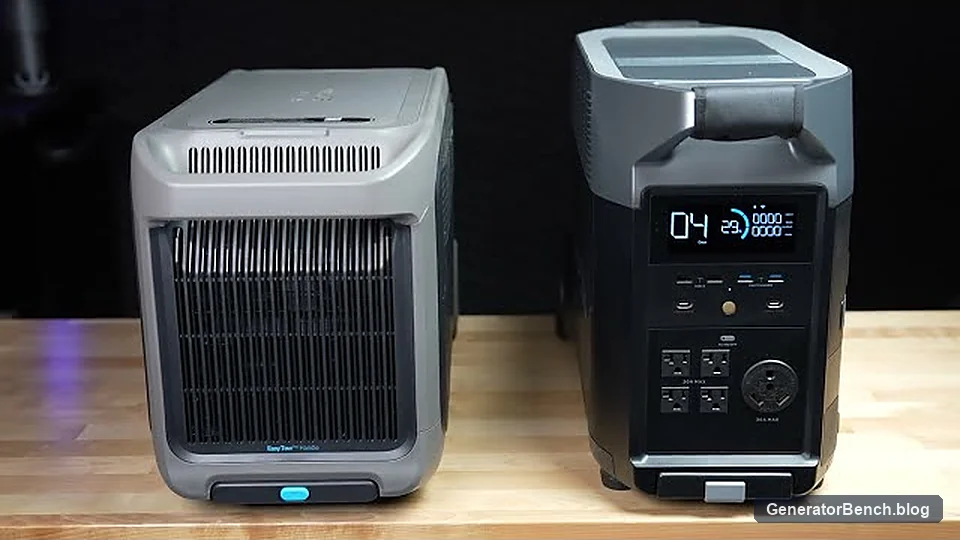
You can examine these physical specifications inside our Ecoflow Delta Pro review, which explains how the telescopic handle and heavy-duty wheels optimize transport across rough outdoor terrain.
The Anker Solix F2000 integrates a unibody drop-resistant frame with industrial-grade automotive plastics, prioritizing mobility via a built-in suitcase handle. Conversely, the EcoFlow Delta Pro relies on an external rolling trolley format for heavy transport.
Structural integrity under thermal stress depends heavily on internal chassis ventilation. Anker uses dual-fan convection channels alongside reinforced internal busbars, while EcoFlow implements a magnesium-aluminum alloy internal skeleton to enhance structural rigidity during transit across rugged terrains.
- Integrated handle versus detachable telescopic systems
- Impact-resistant polymer casing construction
- Optimized weight distribution for single-user transport
- Robust housing materials protect critical internal wiring against high-frequency vibrations encountered during off-grid vehicular transport.
- Ergonomic handle placement reduces physical strain when lifting heavy power stations into elevated truck beds.
Ergonomics and Maneuverability
Moving these heavy power stations requires smart ergonomic planning. Anker builds the handle right into the shell, preventing loose parts during transit.
EcoFlow relies on a detachable pull mechanism that feels sturdy when locked in place.
- Fixed frame durability metrics
- Wheel clearance on gravel surfaces
Chassis Durability and Drop Resistance
Rigorous drop testing ensures that external casing fractures do not compromise internal battery cell security or electrical isolation barriers. Both manufacturers employ reinforced corner bumpers to absorb kinetic impacts effectively during accidental tip-overs.
Field operators must inspect exterior ventilation grilles regularly to prevent dust accumulation from obstructing vital cooling airflow paths inside the main enclosure.
- Impact-resistant polymer shells shield sensitive digital display screens from scratching and cracking hazards.
- Sealed port covers prevent moisture ingress during unexpected rainstorms on remote job sites.
Inverter Capacity and Electrical Output Limits
Comprehensive testing covered in our Anker Solix F2000 review demonstrates how its 2400-watt pure sine wave inverter efficiently delivers stable AC power under heavy continuous electrical loads.
Stepping up the power threshold, the Ecoflow Delta Pro handles a massive 3600 watts continuously. This higher ceiling allows users to run heavy motor-driven appliances without tripping overload protections.
Delivering stable AC power requires robust pure sine wave inverters capable of handling severe inductive loads. The Anker F2000 outputs 2400W continuously with a surge ceiling designed for heavy motorized appliances like refrigerators and circular saws.
Further insights regarding this capacity are detailed in our Ecoflow Delta Pro 3600 review, illustrating how the 3600W continuous output effortlessly handles high-amperage workshop tools.
- Continuous versus surge wattage thresholds
- Pure sine wave distortion ratings under load
- Surge capabilities for inductive compressor loads
- Pure sine wave output prevents electrical humming and premature motor degradation in sensitive medical equipment.
- Advanced microprocessor monitoring protects internal inverter transistors against short-circuit faults and voltage spikes.
Surge Handling for Heavy Appliances
Starting refrigerators and air conditioners demands high instantaneous surge capacity. Both units manage motor startups effectively using proprietary firmware adjustments.
EcoFlow provides extra head room for multi-appliance operation simultaneously.
- Inductive load management profiles
- Thermal throttling protection triggers
Handling Surge Demands and Inductive Loads
Inductive loads require massive initial startup currents that can easily trip standard household circuit breakers or unprotected inverter systems. Both power stations feature intelligent surge suppression modes to handle high initial draw safely.
Technical users should always calculate cumulative running wattages before connecting multiple high-draw appliances to a single inverter output strip.
- Compressor-driven tools demand triple their running wattage during the initial startup phase.
- Overload warnings display immediately on digital dashboards when connected loads exceed rated safety limits.
Battery Chemistry, Longevity, and Cycle Life
Internal chemistry dictates long-term investment value for portable power systems. Both competitors utilize Lithium Iron Phosphate cells rated for exceptional operational longevity.
Users can expect at least 3000 full cycles before capacity drops to eighty percent. This chemistry ensures superior thermal stability during rapid charging phases.
Both power stations utilize Lithium Iron Phosphate (LiFePO4) chemistry to ensure exceptional thermal stability and safety under extreme environmental conditions. This cell type minimizes catastrophic fire risks compared to traditional ternary lithium-ion alternatives.
Long-term degradation metrics indicate both units deliver over 3000 cycles before retaining only eighty percent of their original capacity. Proper ambient temperature management during storage significantly extends this operational lifespan over years of heavy usage.
- LiFePO4 chemical composition safety advantages
- Capacity retention after years of daily cycling
- Advanced battery management system protections
- Advanced battery management systems continuously balance individual cell voltages to maximize overall pack efficiency.
- Chemical stability prevents thermal runaway even when units are operated in enclosed spaces.
Thermal Management Systems
Internal heat buildup degrades battery lifespan rapidly during high-draw operations. Effective airflow design keeps operating temperatures well within safe engineering margins.
Active cooling fans ramp up automatically under high inverter loads.
- Passive heatsink placement efficiency
- Forced-air fan curve optimization
Temperature Limits and Storage Protocols
Charging LiFePO4 batteries below freezing temperatures can cause permanent lithium plating damage inside the microscopic cell structures. Internal heating elements activate automatically in cold environments to prevent hazardous charging conditions during winter.
Long-term storage requires maintaining a partial charge state around fifty percent to minimize chemical degradation over extended periods of inactivity.
- Freezing protection circuits halt incoming electrical currents when internal sensors detect sub-zero temperatures.
- Routine maintenance charging prevents deep self-discharge during off-season garage storage intervals.
Charging Speeds and Energy Input Flexibility
Maximizing off-grid replenishment speeds often relies on photovoltaic arrays recommended in our guide to the best solar panels for Ecoflow Delta Pro, ensuring rapid energy recovery during extended power outages.
Anker utilizes efficient high-wattage solar and AC integration to minimize downtime. Both systems accept high solar array voltages for off-grid energy independence.
Rapid recharging capabilities prevent prolonged downtime during extended grid failures or remote off-grid operations. The Anker model incorporates HyperFlash technology, accepting high AC wattages directly from standard wall outlets without external power bricks.
Meanwhile, the EcoFlow system utilizes X-Stream fast charging circuitry to pull massive power from standard grid connections. Users can safely replenish the enormous internal battery pack from zero to full capacity in less than two hours.
- Rapid AC wall receptacle recharging speeds
- High-voltage solar panel array compatibility
- Smart alternator vehicle charging integration
- Direct wall plug designs eliminate cumbersome external AC adapters that frequently get misplaced during travel.
- Solar input arrays accept wide voltage ranges to accommodate various third-party photovoltaic panel configurations.
Solar Array Integration
Connecting portable solar panels requires robust internal MPPT charge controllers. Both power stations accept wide voltage ranges to optimize solar harvest efficiency.
Clear digital displays report real-time wattage inputs accurately.
- Maximum power point tracking efficiency
- Weatherproof external DC connection ports
Solar Array Integration and MPPT Efficiency
Maximum Power Point Tracking controllers optimize energy harvest from connected solar panels by dynamically adjusting voltage matching parameters. High input voltage tolerances allow users to string multiple panels together safely in series.
Field technicians must verify open-circuit voltages do not exceed maximum controller limits to prevent catastrophic electrical damage.
- High-efficiency MPPT algorithms capture up to ninety-nine percent of available solar energy.
- Anderson power pole connections ensure secure, weather-resistant solar input linking in demanding outdoor environments.
Port Selection and Accessory Ecosystems
Versatile connectivity ensures compatibility with diverse electronic devices and appliances. The front panels feature ample AC outlets, USB-C Power Delivery ports, and specialized RV sockets.
EcoFlow expands functionality further through an extensive ecosystem of smart extra batteries and home integration panels.
Comprehensive port arrays ensure versatile connectivity for modern electronics, medical devices, and heavy-duty field equipment simultaneously. Both generators feature dedicated USB-C Power Delivery ports alongside regulated 12-volt automotive accessory sockets for mobile devices.
Expanding storage capacity requires robust accessory ecosystems like extra battery modules and specialized smart home integration panels. EcoFlow offers a much broader array of expansion options, including dedicated dual-fuel generator integrations and smart home transfer switches.
- Abundant grounded AC receptacle layouts
- High-output USB-C Power Delivery ports
- Proprietary expansion bus connection ports
- Multiple AC household receptacles provide ample plug space without requiring dangerous daisy-chained power strips.
- Dedicated DC Anderson outputs supply high-amperage current for specialized mobile 12-volt refrigeration units.
Smart Home Integration Options
Integrating portable power directly into a home breaker panel requires specialized transfer switches. EcoFlow offers comprehensive hardware solutions for seamless whole-home backup.
Anker focuses heavily on standalone utility and RV applications.
- Manual transfer switch compatibility
- Dedicated smart home circuit panels
Ecosystem Expansion and Smart Home Panels
Integrating portable power stations directly into household electrical panels requires specialized transfer switches and communication cables. These accessories allow seamless backup power transitions during sudden utility grid blackouts.
Users can monitor and control system parameters remotely using dedicated smartphone applications connected via Bluetooth or Wi-Fi networks.
- Smart home hubs automate load shedding to prioritize critical circuits during extended power outages.
- Modular expansion cables feature secure locking mechanisms to prevent accidental disconnection under load.
Acoustic Profiles and Operating Noise Emissions
Fan noise significantly impacts user comfort during indoor emergency operations. The Anker Solix F2000 maintains a remarkably quiet acoustic footprint under normal loads.
When pushed to maximum output, cooling fans on both units increase in volume. Proper placement in well-ventilated areas mitigates ambient noise disruption effectively.
Managing noise emissions is crucial when deploying portable power stations inside residential living spaces or quiet campsites. The internal cooling fans modulate speed dynamically based on active load demands, keeping baseline decibel levels remarkably low.
Under maximum continuous output, both units experience increased fan speeds to dissipate heat effectively from power inverter boards. Maintaining adequate clearance around side ventilation ports prevents thermal throttling during extended high-wattage operational cycles.
- Decibel ratings during moderate inverter loads
- Acoustic frequency tuning of cooling fans
- Thermal fan activation threshold tuning
- Quiet idle profiles ensure uninterrupted sleep when units are placed inside small recreational vehicles or tents.
- Acoustic dampening materials inside the chassis absorb high-frequency fan whine during heavy power delivery.
Indoor Acoustic Comfort
Running a power station inside a bedroom requires minimal background hum. Anker engineering prioritizes quiet fan profiles for sensitive indoor environments.
EcoFlow fans run slightly louder during fast AC charging cycles.
- Low-RPM idle fan states
- Vibration damping rubber feet
Thermal Management and Fan Maintenance
Dust and debris accumulation inside cooling ducts can increase operating noise while reducing overall thermal transfer efficiency. Regular inspection and gentle cleaning of fan intake screens maintain optimal airflow dynamics.
Operating power stations in direct sunlight during hot summer days forces cooling fans to run continuously at maximum speed.
- Variable-speed algorithms prevent annoying fan cycling under steady, moderate electrical loads.
- Thermal sensors automatically throttle inverter output if internal temperatures approach dangerous safety thresholds.
Frequently Asked Questions
Can either of these power stations run a central air conditioner?
Neither unit is designed to run a full central air conditioning system continuously. However, soft-start equipped RV units can be operated for limited durations.
Are these generators safe to store inside a residential home?
Both systems use stable Lithium Iron Phosphate chemistry that prevents thermal runaway. They are completely safe for indoor emergency storage.
How long do these power stations take to fully recharge from a wall outlet?
Using standard AC wall circuits, both units recharge from empty to full in approximately two hours. Their advanced internal chargers maximize input amperage safely.
Can I connect extra battery packs to increase total storage capacity?
Both manufacturers offer modular expansion batteries that plug directly into the main unit. This allows users to scale total watt-hours according to specific needs.
Do these power stations require regular internal maintenance?
Maintenance is minimal and primarily involves keeping firmware updated and vents clean. Users should periodically cycle the battery to maintain internal calibration accuracy.